Lighting for the defence industry and its role
The importance of lighting in a manufacturing facility extends far beyond simply providing visibility. A well-designed lighting system helps create an environment where it is easier to perform tasks that require concentration, inspect surfaces and components, and identify details that are critical to maintaining quality standards.
For this reason, lighting for the defence industry should be evaluated with reference to specific functional zones. Different parameters may be required in a high-bay production hall, at an inspection workstation, or in a warehouse or technical room.
Lighting uniformity is equally important. A high illuminance level alone does not guarantee good visual conditions if significant differences in brightness occur between different parts of a space. Properly positioned luminaires help create a more consistent lighting environment.
Defence industry lighting – technical requirements
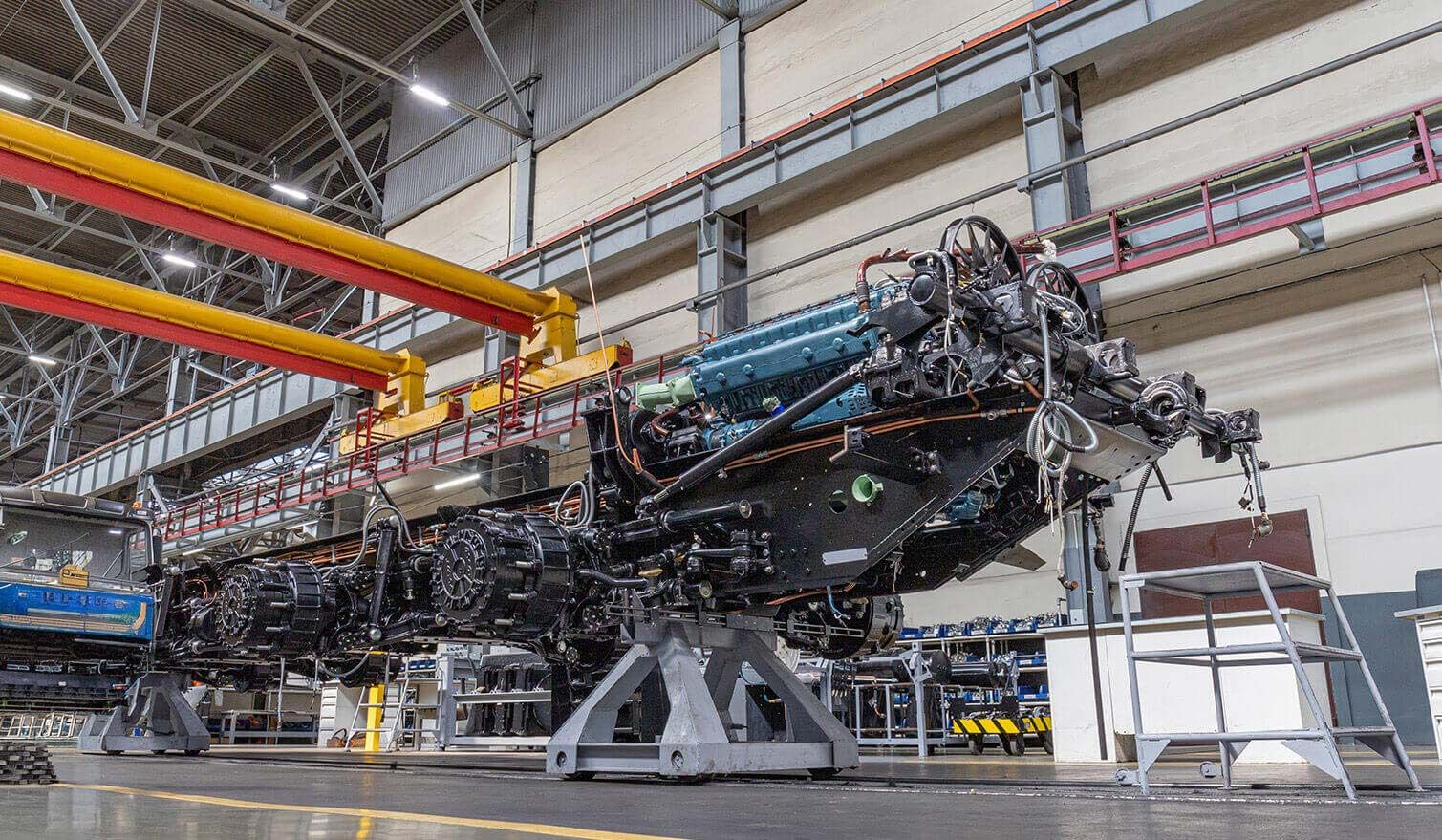
When designing lighting solutions for the defence industry, we focus primarily on parameters that influence visual performance and the durability of the entire installation. Key considerations include appropriate illuminance levels, lighting uniformity, glare reduction, and accurate colour rendering, particularly in areas where precise recognition of details is essential.
The selection of luminaires should also take into account mounting height and room geometry. High-bay facilities require solutions capable of delivering sufficient light to the working plane, while in lower spaces greater emphasis may be placed on glare control and the effective distribution of luminous flux.
The environmental resistance of luminaires is another important consideration. Depending on the nature of the facility, factors such as dust, humidity, temperature, and the intensity of operation may all play a significant role. For this reason, lighting design should always be based on the actual conditions present within the building.
LED lighting for the defence industry
LED technology is particularly well suited to industrial environments, as it combines high energy efficiency with durability and the ability to tailor lighting parameters to specific applications. Properly selected LED lighting for the defence industry can therefore support both workplace comfort and efficient energy management.
For larger facilities, the use of lighting control systems should also be considered. These systems enable lighting operation to be adapted to the use of individual zones, the availability of daylight, and the actual needs of the facility.
Properly designed LED lighting for the defence industry should therefore form part of a broader concept encompassing not only luminaire selection, but also luminaire layout, lighting parameters, control strategies, and operating conditions.