Environmental psychology: Why does space matter?
Environmental psychology examines the relationship between physical surroundings and human behaviour and wellbeing. Over recent decades, its development has significantly influenced the design of public buildings, particularly healthcare facilities.
The underlying principle is straightforward: people do not function independently of their environment. The character of a space, including its scale, acoustics, access to daylight, colour palette, finishing materials and lighting quality, directly affects stress levels, spatial orientation and willingness to engage with others.
In healthcare settings, this relationship becomes especially important because users are often in vulnerable situations. Patients enter healthcare facilities not by choice but because of medical necessity. They frequently experience anxiety, are unfamiliar with the building layout, do not fully understand procedures and have limited control over many aspects of their situation. Any environmental factor that reduces uncertainty and facilitates adaptation can improve psychological comfort.
Light is among the most important of these factors. Its characteristics shape perceptions of space, influence feelings of safety and affect the level of trust patients place in both the facility and its staff.
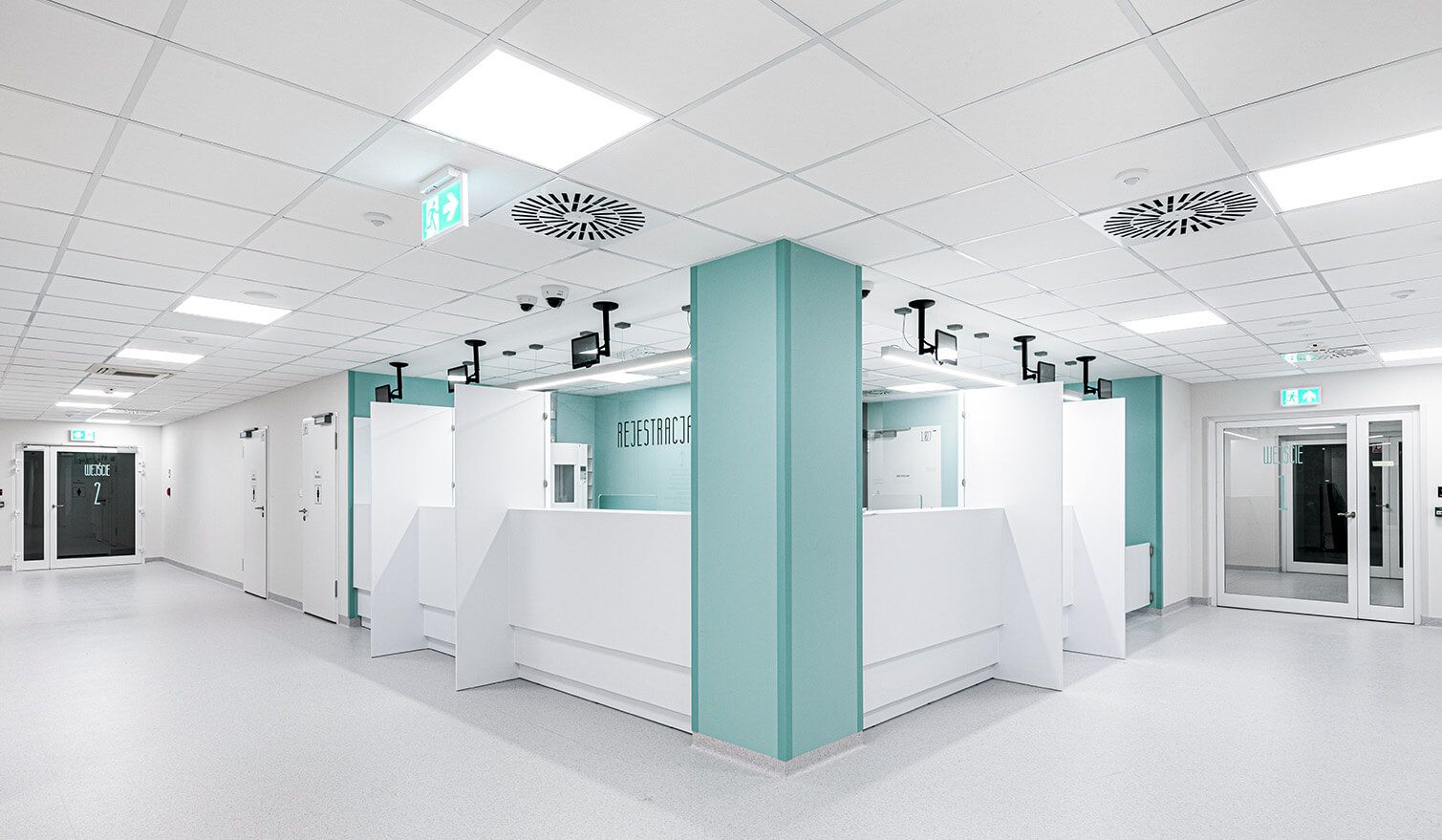
Healing Environment: Creating spaces that support recovery
Modern healthcare architecture increasingly embraces the concept of the Healing Environment, which focuses on creating spaces that actively support recovery. The idea is that hospitals should not function solely as places where medical procedures are performed, but as environments that contribute positively to healing by reducing stress and promoting wellbeing.
This approach considers every aspect of the environment, including access to daylight, contact with nature, acoustic quality, ergonomics, indoor air quality, intuitive spatial layouts and well-designed artificial lighting.
Within this framework, light serves a dual purpose. On the one hand, it enables visual tasks and clinical procedures. On the other, it shapes the atmosphere of a place. The quality of lighting often determines whether a space feels welcoming, calming and reassuring or cold, impersonal and stressful.
For this reason, contemporary hospitals are increasingly moving away from interiors resembling laboratories. Instead, healthcare spaces are often designed with qualities traditionally associated with hotels, wellness centres or modern workplaces. The objective is not to diminish the medical character of the facility but to reduce psychological barriers and create a more patient-centred environment.
Light as a regulator of emotions
The influence of light on human emotions is complex and results from both biological and psychological mechanisms. While the impact of lighting on circadian rhythms is widely recognised, from a psychological perspective it is equally important to understand how light shapes the perception of space and the subjective experiences of its users.
One of the most important factors is luminance distribution, which describes how brightness is distributed across the visual field. Spaces characterised by strong contrasts, dark corners or isolated points of intense light are often perceived as less comfortable and may increase feelings of tension. By contrast, evenly illuminated environments with well-lit walls and ceilings tend to feel more open, organised and secure.
The colour temperature of light also plays a significant role. Cool white light with a higher colour temperature can support concentration and alertness in clinical environments. However, excessive use of cool lighting in patient-focused areas may be perceived as harsh and unwelcoming. Warmer light, by comparison, is often associated with comfort, relaxation and emotional calm, making it well suited to waiting areas, patient rooms and visitor spaces.
Another crucial consideration is glare. Even when illumination levels comply with lighting standards, visual comfort may be compromised if luminaires create discomfort through excessive brightness. Patients spending long periods in bed experience their surroundings from a very different perspective than designers or staff members. Consequently, glare control, appropriate luminaire selection and carefully considered light distribution become important not only for ergonomics but also for emotional wellbeing.
Research that changed the way hospitals are designed
One of the most frequently cited researchers studying the influence of the physical environment on recovery is Professor Roger S. Ulrich, widely recognised as a pioneer of modern Evidence-Based Design. As early as the 1980s, his research demonstrated that seemingly minor environmental factors, such as views of nature from hospital windows, could influence the length of hospital stays, the need for pain medication and patient stress levels.
Although Ulrich's work did not focus exclusively on lighting, it laid the foundation for extensive research into the impact of the physical environment on healthcare outcomes. Subsequent studies have shown that well-designed spaces providing access to daylight, intuitive wayfinding and comfortable artificial lighting can improve patient adaptation to healthcare environments and enhance the overall treatment experience.
Today, many healthcare design guidelines are based on these principles. Modern hospitals increasingly treat lighting as an integral part of the therapeutic environment rather than merely a technical building system.
How does lighting influence patient emotions and the sense of safety?
How can lighting reduce stress during hospitalisation?
Carefully designed lighting can help reduce the emotional strain associated with hospital stays. Uniform illumination, good visual comfort and the absence of excessive glare create environments perceived as calmer, safer and more predictable.
Why do patients perceive healthcare environments differently from staff?
Patients are often experiencing stress, uncertainty and physical discomfort while spending extended periods within the same environment. As a result, environmental factors such as lighting have a greater impact on their psychological wellbeing than they do on healthcare professionals familiar with the space.
Why is lighting important in creating healing environments?
Lighting contributes to a sense of calm, trust and comfort. Together with architecture, acoustics and ergonomic design, it forms part of a holistic environment intended to support both physical recovery and emotional wellbeing.
Summary
Modern healthcare lighting should no longer be viewed solely as a technical building component. Contemporary research in environmental psychology, Evidence-Based Design and Healing Environment design demonstrates that light influences emotions, spatial orientation, stress levels and patients' sense of safety. Properly designed lighting systems can improve comfort during hospital stays, strengthen trust in healthcare facilities and become a meaningful part of environments that support healing and wellbeing.