Light and spatial orientation – reducing uncertainty
One of the most important psychological aspects of hospital design is helping users maintain a sense of orientation.
Healthcare facilities are often complex environments. Patients, particularly older adults, individuals with limited mobility, and visitors, may struggle to find the correct department, clinic, or service point.
A lack of orientation increases stress and feelings of uncertainty.
Lighting can serve as a powerful wayfinding tool that supports spatial orientation.
Properly designed lighting should highlight main circulation routes, emphasise entrances to different areas, accentuate information points, guide users throughout the building, and help distinguish public zones from clinical spaces.
In this context, lighting does more than provide visibility. It becomes an element of architectural communication.
Particularly important is the intentional use of vertical illumination. Bright walls, clearly visible entrances, and illuminated identification elements help users understand the building layout more effectively than simply increasing horizontal lighting levels.
Light in paediatric care – the importance of emotions and a sense of safety
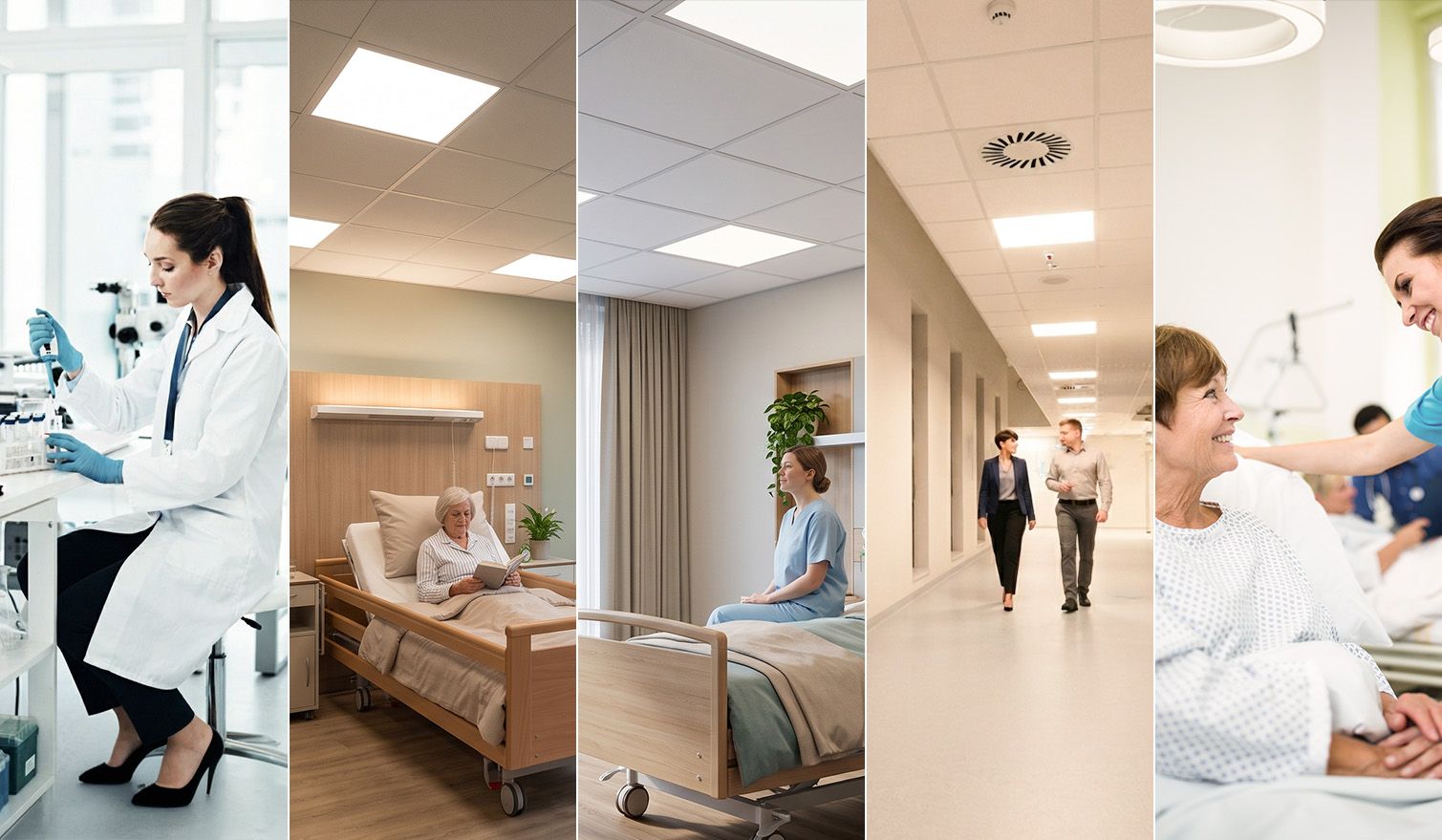
Paediatric departments provide a particularly important example of the psychological impact of light.
For a child, a hospital can be a challenging and unfamiliar environment. New surroundings, unfamiliar medical equipment, healthcare procedures, and separation from everyday routines may generate significant anxiety.
In these spaces, light can play a reassuring role.
Paediatric lighting design is increasingly moving away from the uniform, highly technical lighting typically associated with older hospitals, replacing it with more varied and supportive visual environments.
Common design strategies include:
- softer lighting scenes,
- adaptable lighting environments,
- accent lighting highlighting child-friendly elements,
- solutions that allow a degree of personalisation.
However, maintaining the right balance is essential. A paediatric department remains a healthcare environment, meaning aesthetics must never compromise clinical requirements. Lighting should support both the child's comfort and the safety of healthcare professionals.
Light in oncology and long-term care
Patients undergoing cancer treatment and those receiving long-term care often spend many hours, days, or even weeks in healthcare facilities. In these situations, the physical environment becomes particularly important.
Long-term exposure to an unfriendly environment can increase mental fatigue and intensify feelings of isolation. Lighting is one of the environmental factors that can significantly improve everyday comfort.
The most important considerations in these settings include:
- patient-controlled lighting,
- access to natural daylight,
- reducing visual monotony,
- creating calm lighting scenes,
- minimising glare and harsh contrasts.
When patients can control at least part of their environment, they regain a sense of autonomy and control. This is a critically important psychological factor during long treatment processes.
Common lighting design mistakes from a psychological perspective
⚠️ Focusing solely on lux levels instead of user experience
One of the most common mistakes is treating illuminance levels as the only measure of lighting quality. A room may fully comply with standards while still feeling psychologically uncomfortable. Excessive contrast, poor luminaire positioning, or insufficient vertical illumination are common causes.
⚠️ Using the same lighting approach throughout the facility
Hospitals are not uniform environments. Operating theatres, patient rooms, waiting areas, circulation zones, and consultation rooms all require different lighting characteristics. Applying the same lighting concept everywhere limits the ability to create environments that respond to users' needs.
⚠️ Creating overly technical and unfriendly interiors
Very cool colour temperatures, sterile finishes, and a lack of visual diversity can reinforce associations with a highly technical environment lacking a human-centred character. As a result, spaces may feel less welcoming to patients and visitors alike.
⚠️ Ignoring the patient's perspective
Designers often evaluate spaces from the perspective of a standing user. In reality, patients may spend many hours in bed. Projects should therefore consider the patient's actual field of view, the risk of glare, and the overall visual experience during hospitalisation.
Design recommendations
How can lighting support patients' psychological comfort?
Research in environmental psychology and Evidence-Based Design indicates that well-designed lighting can reduce stress, improve spatial orientation, and strengthen patients' sense of security. In practice, five key principles should guide design decisions.
-
Design lighting for people, not just tasks
Meeting technical standards is essential, but psychological comfort, safety, and the patient's overall perception of space are equally important.
-
Create diverse lighting scenes
Modern lighting systems should adapt to different user needs. Different lighting conditions may be appropriate for:
- medical procedures,
- patient rest,
- waiting areas,
- night-time circulation,
- conversations with patients and families.
-
Reduce stress through clear spatial organisation
Well-lit entrances, information points, and circulation routes help users navigate more easily and reduce feelings of uncertainty.
-
Consider the patient's perspective
Spaces should be evaluated not only from the staff's viewpoint but also from that of patients, who may spend extended periods sitting or lying down.
-
Combine natural and artificial light
The best results are achieved when artificial lighting complements the natural daily cycle, supporting both activity and recovery.
Summary
Lighting is one of the most important elements of a patient's psychological environment within healthcare facilities. Its influence extends far beyond visual comfort, affecting emotions, spatial perception, feelings of safety, and willingness to engage with healthcare staff.
Modern healthcare design demonstrates that well-planned lighting can reduce stress, improve communication, and enhance the overall hospital experience.
The best hospital lighting environment is one that simultaneously provides clinical safety, supports healthcare professionals, and reassures patients that the space has been designed with people in mind.