SDCM (McAdam)
SDCM or MacAdam ellipse is standard deviation of color matching. A chromaticity plot, shows that each color can be formed by a red-green-blue blend and has its own unique number in the chart. Thanks to this, a given color can be represented by an ellipse surrounding the indicated point. The area indicated in the diagram includes color discrepancies that are indistinguishable to the human eye compared to the color inside the ellipse. SDCM is defined as the range of an ellipse around a blackbody, and the smaller the multiplication of the ellipse, the greater the coherence of the light color.
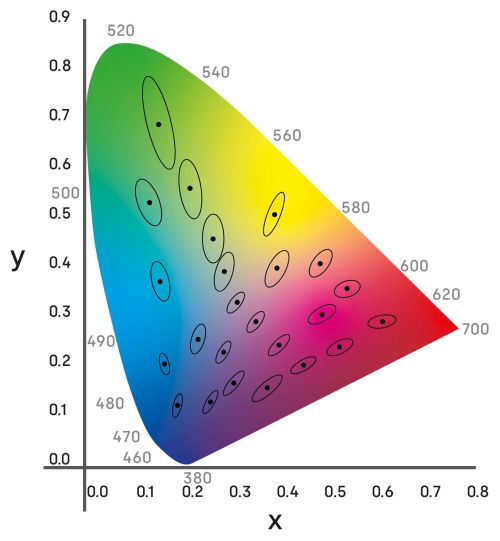
The MacAdams measure also indicates the sort level. LEDs by their "nature", at the production level, differ in color temperature, although they are made to the same specifications. If we want to obtain a homogeneous lighting installation using many luminaires, the LEDs cannot differ significantly from each other. The way to solve this problem is sorting the LEDs according to the scale from the SDCM module. The lower the index, the the color temperature is closer to the original color:
- 1 - 3 is used in places that require uniform color quality
- 3 - 5 with general interior lighting
- 5 - 7 are designed for outdoor environments and products with lower quality requirements.
MacAdam ellipses: history
MacAdam ellipses represent areas on the CIE 1931 chromaticity diagram within which the average observer cannot distinguish differences between colours. They were developed based on psychophysical experiments conducted in 1942 by David L. MacAdam, an American physicist and colour scientist. His research focused on determining how accurately people can match colours under controlled conditions. To achieve this, he developed a chromaticity matching experiment, the results of which were published in the Journal of the Optical Society of America.
MacAdam ellipses and CRI: do they measure the same thing?
Although MacAdam ellipses (SDCM) and CRI (Colour Rendering Index) are often mentioned together, they do not measure the same parameter. MacAdam ellipses define the consistency of white light colour between different luminaires. Thanks to SDCM, it is possible to determine whether various light sources are perceived by observers as having the same colour appearance. CRI, on the other hand, indicates how accurately a light source reproduces the colours of illuminated objects.
Why are LED diodes classified according to MacAdam steps?
During LED manufacturing, small variations may occur, for example during encapsulation and as a result of thermal conditions. These variations lead to chromaticity dispersion between individual LEDs. To control these differences, manufacturers use a process known as binning, in which LEDs are grouped according to their measured chromaticity.
An LED classified within a 3-step MacAdam ellipse (3 SDCM) ensures that its colour remains within the range of perceptible tolerance. This process is essential not only for meeting quality standards but also for preventing noticeable colour differences between adjacent luminaires. Furthermore, it is crucial for maintaining colour consistency in architectural and commercial lighting projects.
SDCM values: where can they occur?
High SDCM values are typically associated with low-cost LED lamps, where quality control procedures are less stringent. As a result, even though the packaging may indicate the same correlated colour temperature, individual lamps can emit light with slightly different colour shades.
The situation is different when it comes to professional lighting products supplied by trusted manufacturers such as ourselves. Leading manufacturers place great emphasis on maintaining low SDCM values, ensuring consistent light colour across an entire luminaire range.
How is SDCM calculated?
MacAdam ellipses are used to calculate SDCM values. The process involves measuring the difference between the colour point of a light source and the target colour point on the chromaticity diagram. The greater the distance between these points, the greater the colour deviation.
However, measuring and controlling SDCM values in finished LED luminaires is a significant challenge. It requires advanced measurement equipment and rigorous quality control procedures. Professional manufacturers such as ourselves continuously improve luminaire design techniques and testing methods to achieve low SDCM values and outstanding colour consistency.
By continuously expanding our expertise, enhancing our capabilities, and investing in research and development, we are able to deliver excellent results and maintain the highest standards of lighting quality.
Frequently asked questions (FAQs) about the SDCM and standard deviation of colour matching:
What is color temperature?
The color temperature of LEDs differs despite identical specifications. SDCM sorting helps maintain light color consistency.