Light-emitting diode
Light-emitting diodes (LEDs) belong to the 4th (latest) generation of artificial light sources used by man in lighting so-called Solid State Lighting (SSL). The first 3 generations are: sources using the combustion process (I), incandescent lamps (II) and discharge lamps (III).
A light-emitting diode, also known as a light-emitting diode (LED), is one of the semiconductor optoelectronic devices that convert electrical energy into electromagnetic radiation energy. LEDs are usually produced as compounds of elements of groups III and V of the periodic table. In practice, both binary and multicomponent compounds are used, with the composition selected so that the semiconductor structure obtained in the technological process allows the emission of light in a given spectral range.
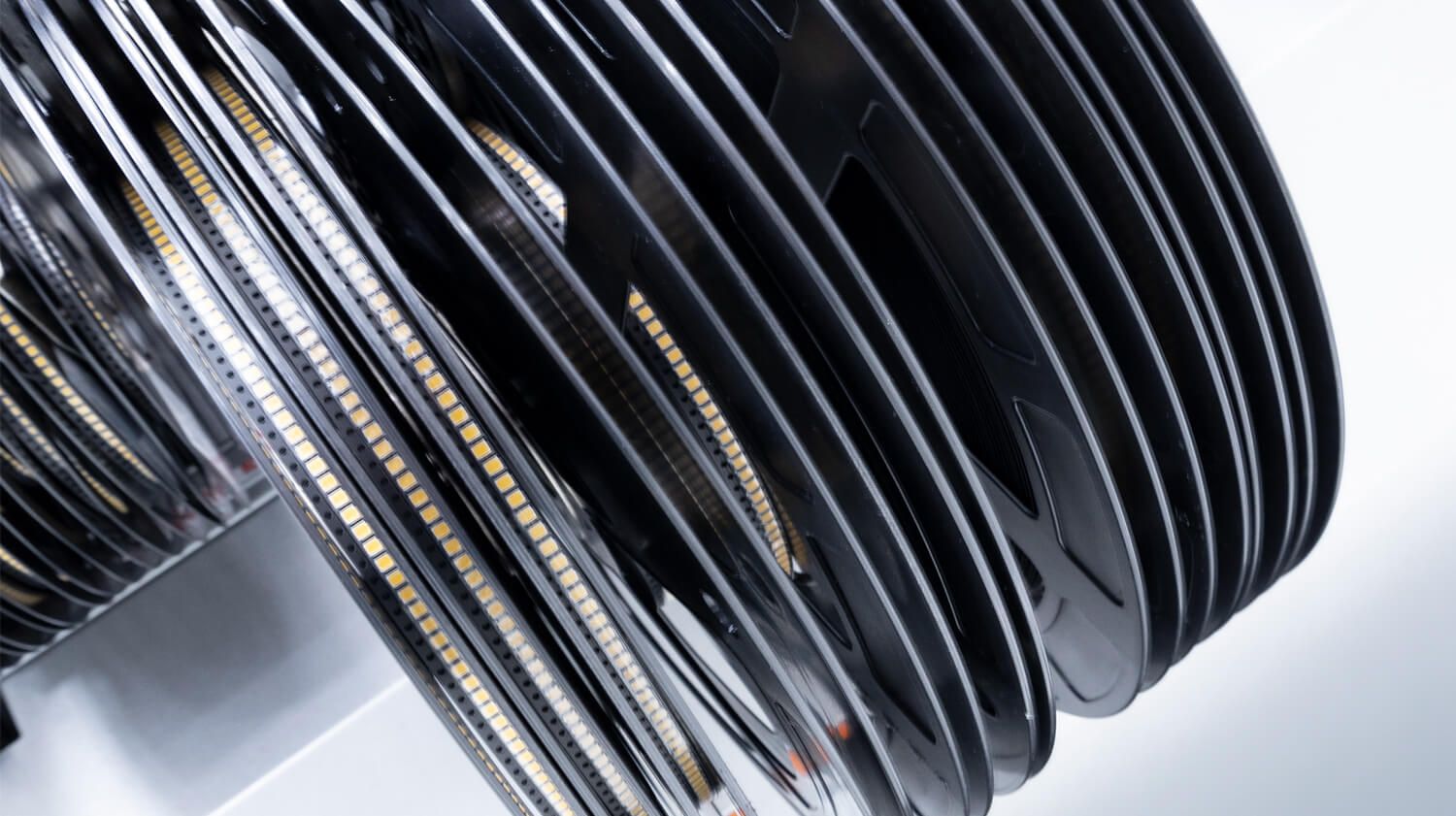
The least complex LEDs are realized in the form of ordinary semiconductor p-n junctions, which, when polarized with a sufficiently large voltage in the direction of conduction, emit electromagnetic radiation in the visible and infrared light range. The wavelength of the radiation emitted by LEDs, and thus its color, depends on the semiconductor material from which it is made.
The operating principle of an LED is based on the phenomenon of electroluminescence, which involves the production of light under the influence of an electric field. Electroluminescence occurs as a result of recombination of holes and electrons in the p-n junction region. The transition of electrons from a higher energy level to a lower one is accompanied by the release of energy in the form of heat (non-radiative recombination) or light (radiative recombination). Non-radiative recombination occurs in semiconductors with an oblique energy gap, such as Si or Ge. Radiative recombination is characteristic of semiconductors with a straight energy gap. This type of recombination, during which energy is released in the form of radiation quanta - photons, occurs in materials such as GaAs, InAs, InP, InSb, for example.
LED light-emitting diode
LED technology has changed the way we think about lighting by enabling the creation of durable, energy-efficient luminaires precisely tailored to a building’s function. An LED light-emitting diode produces light when electrical energy is applied to a semiconductor junction. This makes it possible to achieve high luminous efficacy while keeping energy consumption low.
Advantages of LED light-emitting diodes
The greatest advantage of this type of solution is the combination of energy efficiency, durability, and excellent control over light quality. LED light-emitting diodes reach full brightness almost instantly, integrate well with lighting control systems, and enable the creation of installations adapted to users’ working patterns. Compared with traditional light sources, they reduce energy losses while providing the desired light colour, intensity, and beam direction.
For our team, it is also important that this technology supports sustainability goals. Lower energy consumption, long luminaire lifespans, and intelligent control capabilities help reduce both operating costs and environmental impact. This is why LED luminaires are widely chosen for both refurbishment projects and new developments.
Applications of light-emitting diodes
LEDs are used in a wide range of lighting solutions, from simple technical luminaires to advanced systems designed for large-scale facilities. Light-emitting diodes can be incorporated into industrial, street, architectural, office, task, emergency, and specialist lighting applications.
A high-bay warehouse has different lighting requirements than a retail space, and these differ again from those of a car park, corridor, production hall, or building façade. Properly selected light sources improve visibility, safety, working comfort, and the overall aesthetics of a space.
What should you know about LED light-emitting diodes?
When selecting a luminaire, it is not enough to consider a single parameter. Key factors include luminous efficacy, durability, colour temperature, colour rendering index (CRI), light distribution, mechanical resistance, ingress protection, and thermal management.
A well-designed luminaire should operate reliably over a long period while maintaining performance levels that meet the needs of the facility. As a lighting manufacturer, we combine design expertise, in-house technological capabilities, and experience gained through projects delivered in both domestic and international markets. This allows us to provide solutions that are not only efficient but also aesthetically appealing, certified, and ready to perform in demanding environments.
Our goal is to create lighting that supports people, reduces operating costs, and contributes to more energy-responsible spaces. We also assist customers during the selection, measurement, and configuration stages to ensure that the completed installation is practical, safe, and aligned with project requirements. This results in easier investment planning, better control of energy consumption, and greater predictability of building maintenance costs.